IT Recruiting
The Rise of the GTM Engineer: What They Do, How to Become One, and Why They’re in Demand

Five years ago, the GTM Engineer didn’t exist.
It wasn’t even a thing yet.
Since 2024, around 100 new GTM Engineer job postings go live every month. Companies like OpenAI, Cursor, Webflow, and Clay are actively hiring for this role. And according to McKinsey 2025 and PwC data, AI-powered go-to-market systems are delivering 40% efficiency gains for teams that adopt them.
So what exactly is a GTM Engineer? Why has this role exploded in demand? And should your company have one?
What is a GTM Engineer?
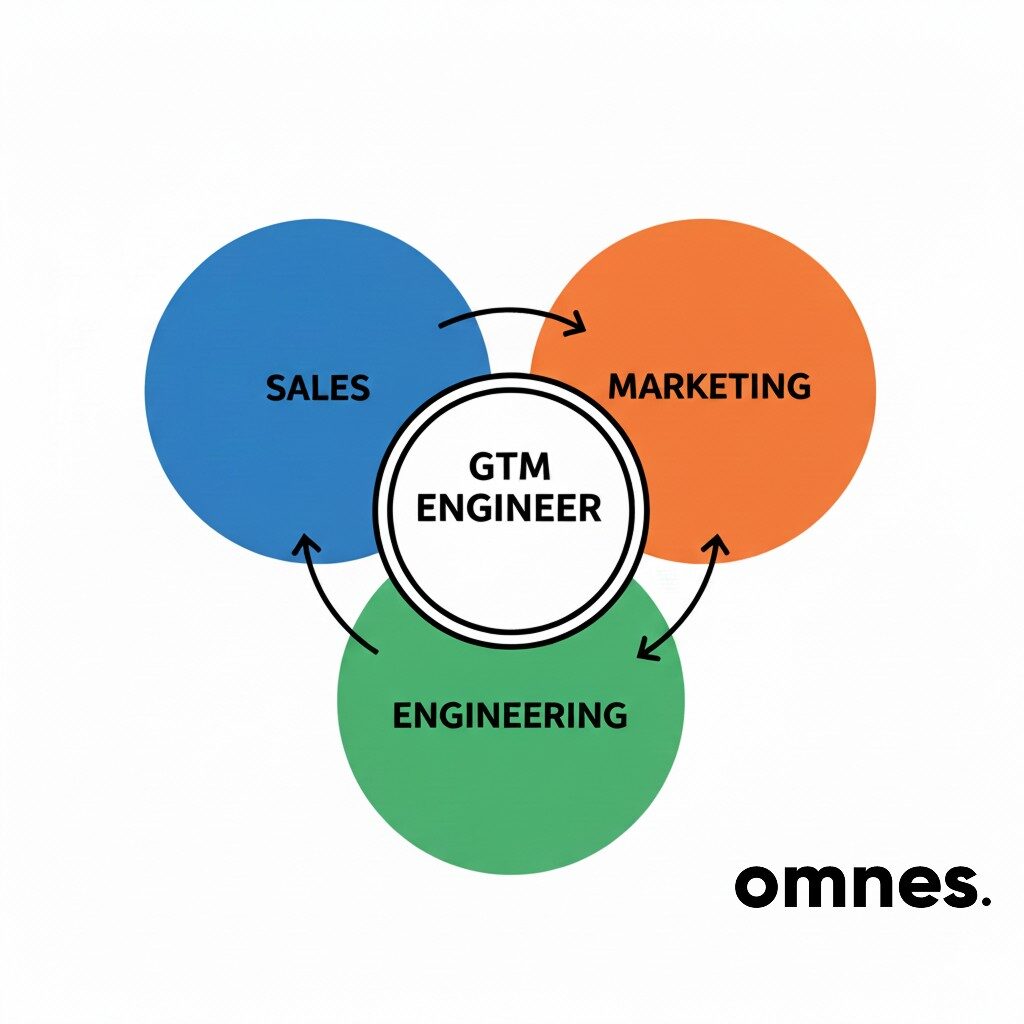
A GTM Engineer, short for Go-To-Market Engineer, is a technical professional who builds the systems, workflows, and automations that power a company’s entire revenue engine. They sit at the intersection of sales, marketing, and engineering, connecting tools, data, and processes that were previously siloed.
Think of them as the architect behind your go-to-market motion.
They’re not traditional software engineers building product features. Instead, they build the infrastructure that helps companies acquire customers faster, convert leads more efficiently, and scale revenue without proportionally scaling headcount.
A GTM Engineer is essentially Sales Development, Marketing, and RevOps all wrapped into one employee.
Where a traditional sales development rep might manually research prospects and send cold emails, a GTM Engineer builds automated systems that do this at scale: with personalization, data enrichment, and intelligent routing built in.
Why the GTM Engineer role emerged
The role didn’t appear out of nowhere. Several forces converged to create the demand. Clay coined the term “GTM Engineer” and has become the central orchestration layer for modern go-to-market systems. Their platform enables the data enrichment and workflow automation that GTM Engineers rely on.
- The pressure to do more with less
When VCs pulled back funding in 2023, startups had to maintain or accelerate revenue growth without expanding headcount. The old playbook of “hire more SDRs” stopped working. Customer acquisition costs kept rising. Pipeline velocity slowed. Teams needed a different approach.
2. The explosion of AI and automation tools
As tools like ChatGPT, Claude, and Clay matured through 2024, companies realized they had access to powerful automation capabilities—AI-powered lead scoring, automated email sequences, intelligent forecasting, personalized messaging at scale. But most marketing and sales leaders didn’t have the technical skills to actually implement them.
Someone needed to wire it all together. That someone became the GTM Engineer.
3. Fragmented tech stacks
The average sales team now uses five or more disconnected tools. Research shows sales reps spend 65% of their time navigating fragmented systems and manual workflows rather than selling. Leads go cold during the 6-48 hours it takes to validate and route them. Valuable buying signals get lost.
GTM Engineers emerged to solve this exact problem: integrating tools, automating handoffs, and making data flow seamlessly across the entire customer journey.
The shift from outbound to GTM systems
A few years ago, outbound meant cold email and cold calls. Write good copy, get replies, book meetings.
That playbook doesn’t really work anymore.
Most teams have overused the same data sources, the same sequences, and the same tools. Inboxes are crowded. Response rates have plummeted. The real advantage now comes from how your system connects everything together.
Here’s what a connected GTM system looks like in 2025:
- Data Sources: Apollo, Sales Navigator, Ocean.io, Clearbit
- Engagement Tools: Masterinbox.com, Extrovert
- Signal Detection: RB2B, Common Room
- Orchestration: Clay
- Outreach Platforms: Smartlead
- Automation Layers: Make, n8n
- CRM: HubSpot, Attio
The GTM Engineer is the person who wires all of these together into a cohesive system, one that identifies the right prospects, enriches their data, detects buying signals, triggers personalized outreach, and routes responses to the right people automatically.
What does a GTM Engineer actually do?
This is a high-impact role for someone who loves shipping fast, experimenting often, and using code plus creativity to drive pipeline and revenue. You won’t just support growth, you’ll engineer it.
Core Responsibilities
- Build Automated, AI-Driven GTM Workflows
GTM Engineers design and implement systems that automate the entire customer acquisition process. They build lead scoring models, automated qualification flows, and intelligent routing systems that reduce response times from hours to minutes.
- Launch Personalized Campaigns at Scale
Rather than sending the same message to every prospect, GTM Engineers create hyper-personalized outbound campaigns that leverage AI to customize messaging based on company data, recent activities, and behavioral signals.
- Create Internal Tools and Agents
They build the tools that help sales and marketing teams move faster: custom dashboards, automated research assistants, quote generators, and data enrichment pipelines.
- Run Rapid Experiments
A/B testing, conversion optimization, new channel exploration. GTM Engineers treat go-to-market like a product—constantly iterating based on data and results.
- Integrate and Manage the Tech Stack
CRMs, marketing automation platforms, data enrichment tools, outreach systems. GTM Engineers ensure everything talks to each other and data flows cleanly across systems.
The skills required to be a GTM Engineer
A true GTM Engineer needs a well-rounded skill set that combines technical depth with business acumen and communication skills.
Technical skills
The most common tools include Clay (orchestration), HubSpot and Salesforce (CRM), Zapier and Make (automation), Apollo and Clearbit (data enrichment), and Outreach or Smartlead (sales engagement).
- Programming Fundamentals: SQL and Python appear in 38% of GTM Engineer job postings. You need to be comfortable writing scripts, querying databases, and building custom integrations.
- API Integrations: Understanding how to connect different systems through APIs is essential. Most GTM work involves making tools talk to each other.
- CRM Expertise: Deep knowledge of platforms like Salesforce and HubSpot is table stakes. You’ll be building on top of these systems constantly.
- Automation Platforms: Clay, Zapier, Make, n8n—these are the building blocks of modern GTM systems.
- Data Analysis: The ability to analyze funnel performance, identify bottlenecks, and make data-driven decisions.
Strategic and creative skills
- Copywriting: Building automated outreach means nothing if the messaging doesn’t convert. GTM Engineers need to craft messaging that resonates.
- Strategic Thinking: Understanding the entire customer journey and identifying where automation can have the biggest impact.
- Experimentation Mindset: Constantly testing new approaches, measuring results, and iterating.
Soft skills
- Cross-Functional Communication: GTM Engineers work across sales, marketing, product, and engineering. They need to speak both “tech” and “business” fluently.
- Account Management: Whether handling internal stakeholders or agency clients, managing expectations and relationships is critical.
- High Pressure Tolerance: This is not a role for the faint of heart.
It’s a high pressure role.
Let’s be honest about what this job actually demands.
Your work is tied directly to results. You need to keep clients happy. You need to keep management happy. And you need to be consistent.
One bad month, even one bad week, and the spotlight is on you.
GTM Engineering is an elite discipline. Less than 1% of salespeople will ever master it. The combination of technical skills, strategic thinking, copywriting ability, and stakeholder management required is rare.
But for those who thrive under pressure and love seeing direct impact from their work, it’s one of the most rewarding roles in modern tech.
GTM Engineer vs. RevOps
An analysis of 1,000 job postings found that 9 out of 10 responsibilities in GTM Engineer roles also appear in RevOps postings. The core difference? RevOps roles lead with CRM ownership and treat it as the foundation. GTM Engineer roles lead with automation and integration, putting CRM tasks third or fourth.
RevOps focuses on keeping systems running and accurate. GTM Engineers focus on building new processes that directly drive pipeline.
GTM Engineer vs. Growth Hacker
Traditional growth hackers often focus on product-led growth tactics—virality, referral loops, conversion optimization. GTM Engineers are more focused on the B2B revenue engine—outbound, sales enablement, and the systems that connect marketing qualified leads to closed revenue.
GTM Engineer vs. Sales Ops
Sales Ops typically manages existing processes and tools. GTM Engineers build new ones. They’re not shy about writing custom scripts or integrating new AI tools if it means booking more demos.
GTM Engineer salary
The compensation reflects the impact and scarcity of the role.
Salary Ranges
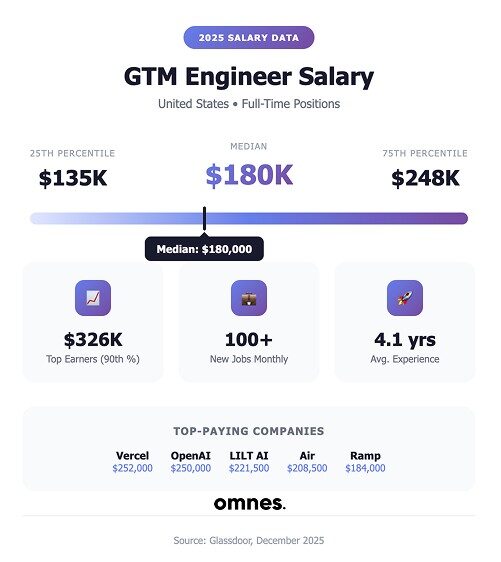
According to Glassdoor, GTM Engineers earn between $135,000 and $248,000 per year in the United States, with a median around $180,000. Top-paying companies like Vercel ($252,000), OpenAI ($250,000), and LILT AI ($221,500) offer premium compensation.
Job postings with public salary ranges show a median of $127,500, though this varies significantly by company size, location, and experience level.
Career paths
GTM Engineers can progress in several directions. Many become Heads of Growth or Directors of Revenue Operations, overseeing teams of analysts and ops specialists. Others remain hands-on, continuing to push the boundaries of automation. Some branch out as consultants, offering “GTM Engineering as a Service” to multiple clients.
Given the scarcity of this skill set, experienced GTM Engineers rarely struggle to find opportunities.
Market demand
The demand is accelerating. Over a third of all current GTM Engineers started their roles in 2024 or later. The average experience requirement is 4.1 years, indicating there will be a lot of memes.
How to Become a GTM Engineer
If you’re looking to break into this field, here’s the path.
Build Your Technical Foundation
Learn SQL and Python—they appear in nearly 40% of job postings. Get comfortable with data manipulation, API integrations, and automation scripting. You don’t need to be a software engineer, but you need enough technical skill to solve problems independently.
Master the Core Tools
Clay is the most mentioned tool in GTM Engineer job postings (the company literally coined the term). HubSpot appears in 52% of postings, Outreach in 49%, and Salesforce in 45%. Zapier shows up in 39%.
Learn at least one CRM deeply. Understand how data enrichment platforms work. Get hands-on experience with automation tools.
Gain Go-To-Market Experience
Work in sales development, marketing operations, or revenue operations first. Understand the pain points of these roles intimately. The best GTM Engineers have lived the problems they’re now solving.
Get Certified
Salesforce Administrator certification, HubSpot certifications, and SQL/data analytics credentials all demonstrate expertise to potential employers.
Start Building
Create your own workflows. Automate something for a small business. Document your experiments and results. The best way to prove you can do this work is to show examples of it.
Should your company hire a GTM Engineer?
Here’s the question every founder and revenue leader should ask: Are you sticking to the old ways? Do you believe they’ll still work?
Every company should have someone managing workflows, CRM enrichment, and outbound campaigns with a technical, data-driven approach.
Teams should be more technical, more data-driven, and more capable of plugging data into custom workflows. That’s not going anywhere.
People will keep using data across more tools, more systems, and more custom setups. The companies that figure out how to do this well, by hiring GTM Engineers or developing these capabilities internally, will have significant advantages over those that don’t.
Key takeaways
A GTM Engineer is a technical professional who builds the systems, workflows, and automations that power revenue growth. The role combines sales development, marketing, and RevOps into one position.
The role emerged from the pressure to do more with less, the explosion of AI tools, and the need to integrate fragmented tech stacks.
Required skills include programming (SQL, Python), CRM expertise, automation platforms, copywriting, and cross-functional communication.
Salaries range from $90,000 to $250,000+, with top companies like Vercel and OpenAI paying at the high end.
This is a high-pressure, results-driven role where your work directly ties to pipeline and revenue. It’s not for everyone—but for those who thrive in it, the impact and rewards are substantial.
The shift from simple outbound to connected GTM systems is accelerating. Companies that adapt by building GTM Engineering capabilities will have significant competitive advantages.
Ready to scale your data team with professionals who combine technical expertise with business impact? At Omnes Group, we specialize in connecting companies with GTM talent who don’t just understand the technology: they understand how to apply it to your specific challenges. Schedule a call with our recruiters to discuss your hiring needs.